From Fourier Series to FFT
From Fourier Series to Fourier Transform | Part 1

The Fourier Series, proposed by Jean-Baptiste Joseph Fourier in 1822, can only model repeating signals. It took the further work of Peter Gustav Lejeune Dirichlet to expand the capabilities of the Fourier Series so that it could model non-repeating signals. However, the Fourier Transform, as it became known, is by no means a one-stop-shop. Yes, it can model more of the signals one is likely to meet in the real world, but it is not without its limits. What changes did Dirichlet make to turn the Fourier Series into the Fourier Transform and what can and can’t the Fourier Transform do?
From Fourier Series to Fourier Transform | Part 2

Peter Gustav Lejeune Dirichlet made two major changes to the Fourier Series to turn it into the Fourier Transform. Both of these changes involve infinities. Having dealt with the infinite integral in the last post, we now look at how Dirichlet turned a discrete series into a continuous function of frequencies.
In mathematical terms, what does mean to be discrete, and why do we need a continuous function of frequencies to describe a signal that doesn’t repeat itself?
Destructive Interference and how to extend the silence
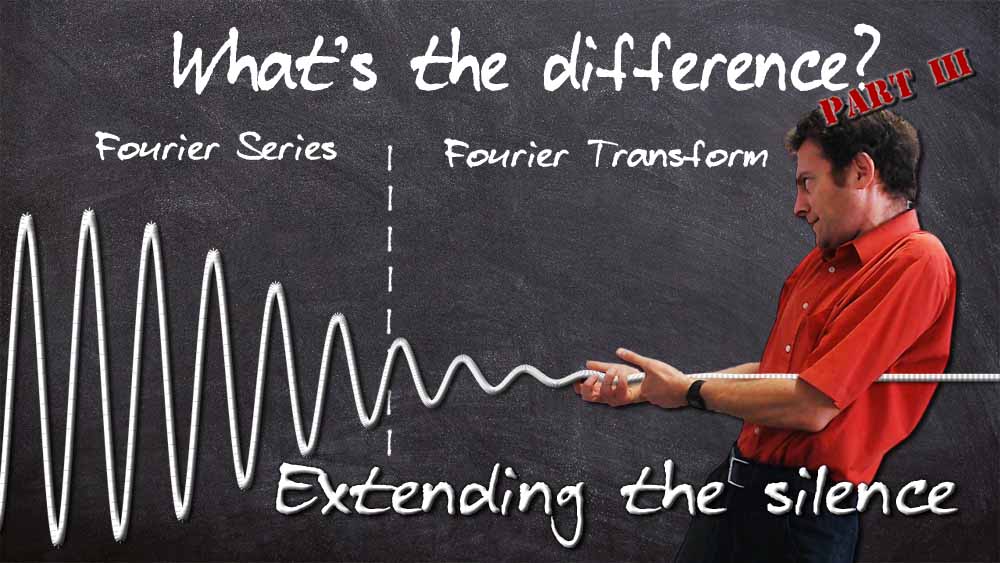
We have advanced in our quest to do what the Fourier Transform does and build a non-repeating signal out of sine waves; however, although this is an improvement, it’s still not the kind of signal you would find in the real world. Real-world signals are much shorter. Somehow, we have to find a way to lengthen the amount of time for which the signal is silent.
What is the DTFT? (Discrete-Time Fourier Transform)
The Discrete-Time Fourier Transform (DTFT) is a further development of the Fourier Transform. However, whereas the Fourier Transform treats time as continuous, The Discrete-Time Fourier Transform, as its name suggests, thinks of time as a discrete list of individual moments. But what is so special about the DTFT and how does it work?